biblissim-ia-2026 : Automatic Text Recognition, and Then? Biblissima+ Cluster 3 Days 2026
Aubervilliers (France)
15-17 Jun 2026

biblissim-ia-2026 : Automatic Text Recognition, and Then? Biblissima+ Cluster 3 Days 2026
Aubervilliers (France)
15-17 Jun 2026
Biblissima+ (Observatory of Written Cultures, from Clay to Print), hosted by the Campus Condorcet, is one of the major research infrastructures (ÉquipEx+) funded under the French Investissements d'avenir programme. It builds upon the earlier ÉquipEx Biblissima (Bibliotheca bibliothecarum novissima) and establishes a multipolar digital research infrastructure dedicated to both fundamental research and scholarly services in the history of the transmission of ancient texts — from the earliest Mesopotamian clay tablets to the first printed books, across all media and languages. Biblissima+ is structured around seven areas of expertise, or “clusters,” organized according to the data life cycle. The work of Cluster 3, “Artificial Intelligence and the Recognition of Forms and Handwritten Scripts,” coordinated by Dominique Stutzmann (Senior Research Director, IRHT-CNRS UPR841) and Daniel Stökl Ben Ezra (Director of Studies, EPHE-PSL, AOROC UMR 8546), focuses on the use of artificial intelligence for the recognition of forms, characters, and handwritten scripts. These technologies enable the study of manuscript and early printed books, as well as sigillography, numismatics, and heraldry. The cluster addresses large-scale and heterogeneous datasets, encompassing diverse materials, languages, and writing systems relevant to Biblissima+. Its work is carried out in close collaboration with the other clusters in order to formalize text, process images, read texts, and interpret them. The cluster aims to broaden access to infrastructures and data, and to provide users with the most powerful possible tools while respecting the precision and diversity of historical research. Biblissima+ receives state funding managed by the French National Research Agency (ANR) under the Programme d'investissements d'avenir, integrated into France 2030 (reference ANR-21-ESRE-0005).
Biblissim-IA-2026: Cluster 3 Days Following the Biblissim-IA editions of 2023, 2024, and 2025, the 2026 Cluster 3 Day of Biblissima+ seeks to contribute to ongoing reflections on the future of medieval manuscript studies and analysis in the age of artificial intelligence, particularly in light of the publication of large-scale handwritten text recognition models. What new avenues are now open for the cataloguing and scholarly expertise of medieval manuscripts? What perspectives emerge for related fields such as linguistics, literary history, and art history?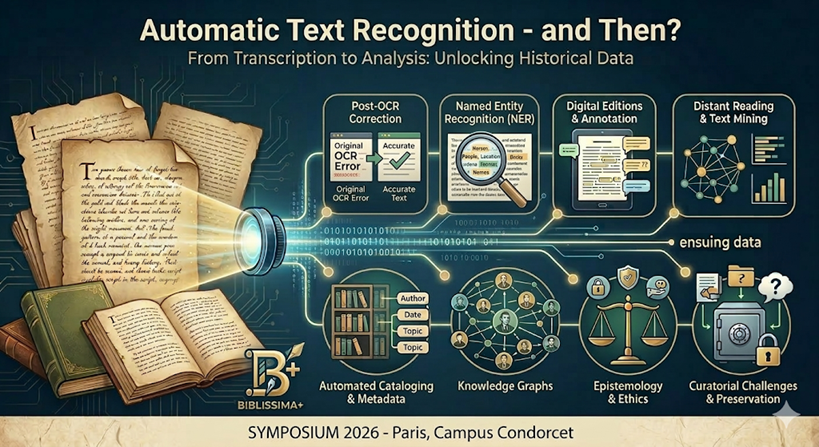
 Loading...